

TECHNOLOGY
Optical components play an important part in many modern devices, ranging from miniature cameras to mobile phones and medical applications such as endoscopes to high-performance optical sensors of ever-decreasing size in industry and robotics.
In all optical applications, the commonly occurring yet detrimental reflection of light is still a problem. These reflections make images appear darker, interfere with the optical path, produce „ghosting“ and can even seriously damage devices in certain laser applications. In order to reduce these undesirable reflections, thin film anti-reflective coatings have been used up to now. These very thin layers of special materials are however only effective within very small wavelength ranges and have a relatively low mechanical strength and durability.
Some insects have had the solution to this problem for millions of years. On the surface of a moth’s eyes for example, miniscule, conical nanostructures ensure an almost complete absence of reflection.
The newly-developed nanoAR process makes affordable production on a large scale possible. Applications includes lens and optical sensing systems, touchscreen displays and devices, spectroscopy systems, microscopy, medical devices, spectroscopy, light extraction and light harvesting devices, illumination, sensor and communication sensor technology.
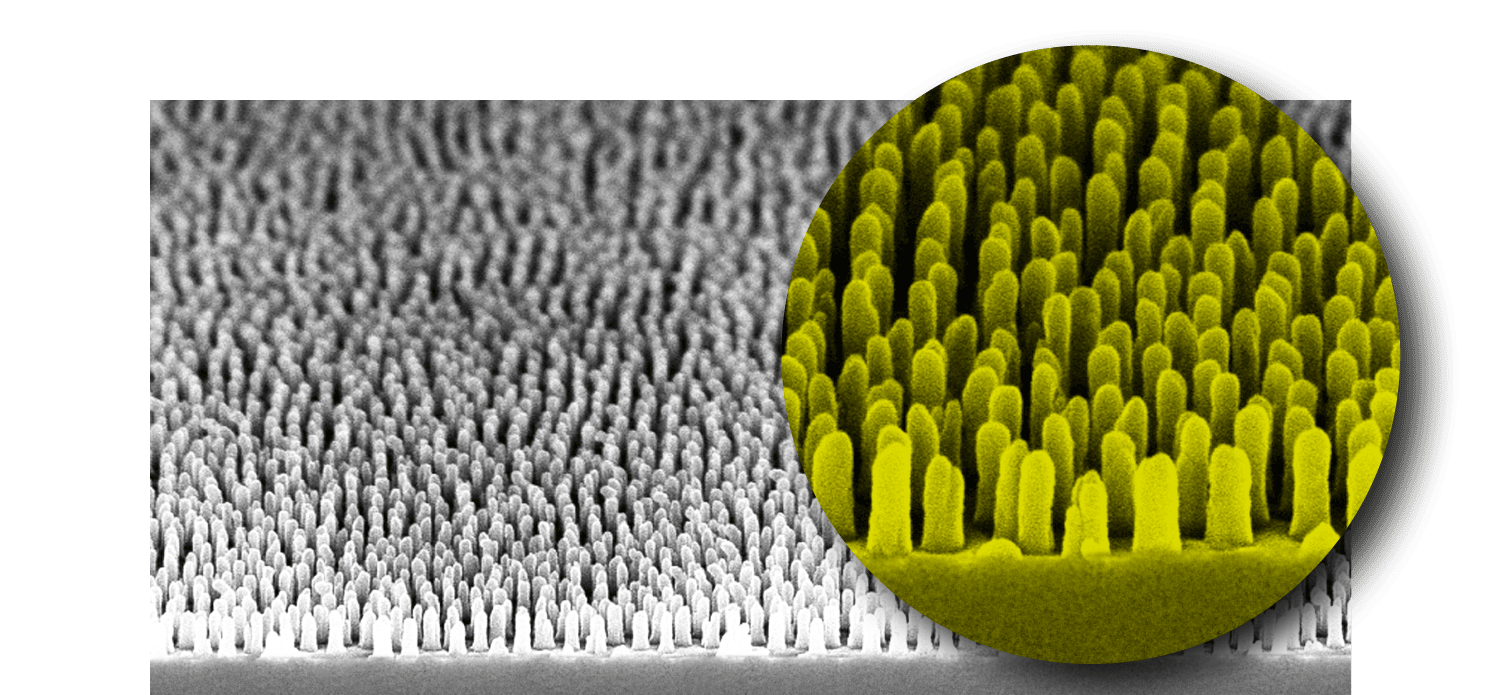
SEM image of nanoAR anti-reflection structures in fused silica (×20000 magnification).
Insert: ×50000 magnification zoom.
COMPANY
nanoAR develops and produces optical anti-reflective (AR) nanostructures using the unique nanoAR-technology.
Optics with nanoAR technology anti-reflex coatings find their applications in the fields of lens and optical sensing systems, touchscreen displays and devices, spectroscopy systems, microscopy, medical devices, spectroscopy, light extraction and light harvesting devices, illumination, sensor and communication sensor technology.
If you have questions regarding a certain application, please contact us to discuss your needs. This may be the starting point for a new innovative solution.
TEAM
We are an experienced team of scientist and engineers with a fundamental background in physics and optics and a strong technical know-how.
MANAGING TEAM
Dr. Zhaolu Diao, CEO
Dr. Diao has degrees in photonic from Ecole polytechnique fédérale de Lausanne.
His focus is on project management, research and development, and direct customer contact.
Dr. Klaus Weishaupt, COO
Besides having a background in physics Dr. Weishaupt has more than 20 years of experience as entrepreneur
in high-tech companies. He will focus on building the company, strategic orientation, and market development.
Dr. Xiaodi Hong, CTO
Dr. Hong brings her expertise in biochemical process engineering to the company. She will drive forward technical development and process optimization.
ADVISORY BOARD
Prof. Dr. Joachim Spatz
Max-Planck Institute for Medical Research (Heidelberg) and Ruprecht-Karls-Universität (Heidelberg)
PATENTS
nanoAR is the exclusive licensee of several patent families held by the Max Planck Society. The nanoAR team members are registered as inventors of those patents.
To expand and maintain our patent portfolio we work in close collaboration with Max-Planck-Innovation GmbH. Please contact us to learn more about our IP.
PUBLICATIONS
- nanoptaflyer (313 KB)
NANOAR – PROCESS FOR NANOSTRUCTURED ANTI-REFLECTION COATINGS OF SURFACES




The newly-developed nanoAR process makes affordable production on a large scale possible. Applications include high power laser systems, optical sensing systems, touchscreen displays and devices, spectroscopy systems, potential stealth applications, light extraction and light harvesting devices.
TRANSMITTANCE NANOAR VERSUS CONVENTIONAL COATING
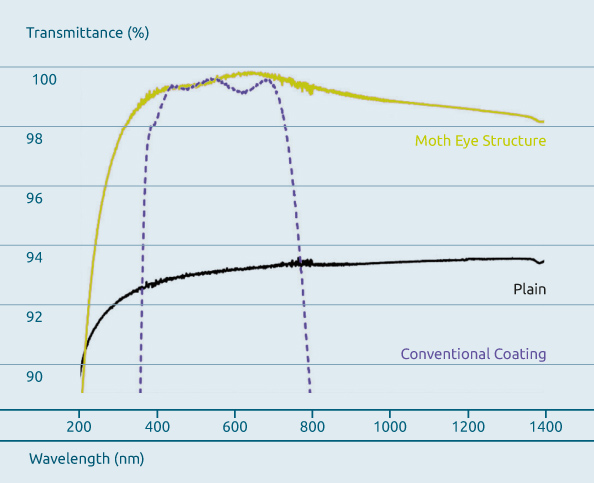
Yellow curve: Transmittance of nanopillars in fused silica (spacing 100 nm, height 450 nm). The maximum is 99.8% at wavelength 700 nm.
Dashed curve: Transmittance of conventional multilayer broadband AR coating on the same substrate. The operation wavelength band is narrower and the maximal transmittance is lower than nanoAR structurers.
The nanoAR technology was developed at the Max-Planck-Institute for Medical Research and the Max-Planck-Institute for Intelligent Systems. The nanoAR research is funded by the Max-Planck-Society and the German Ministry of Education and Research.
SERVICES
Advanced Technologies for your anti-reflection requirements
Your idea is the starting point of new developments. We develop for you the realization of this idea to the finished products with the possibilities of our nanoAR-technology. In the course of this we constantly leave behind the conventional thinking of thin film techniques and we turn to innovative solutions.
We offer the complete process chain from consulting through to design, purchase of the substrate and on to processing and packing. Our metrology methods and tests are available for analyzing optical coatings in line with customer requirements or common standards. We are also able to produce small quantities during your product development.
Nano-structured anti-reflex coatings for your optical components
- nanoptaflyer (313 KB)
AWARDS
LOTHAR-SPÄTH-AWARD
The Lothar-Späth-Award-Foundation is offering the Lothar-Späth-Award in the federal states of Baden-Württemberg and Thuringia, which honours the work, pioneering achievements and exceptional personality of Prof. Dr. h. c. Lothar Späth in business, politics and society (www.lothar-spaeth-award.de).

Photo: Wolfgang List

CONTACT
Please do not hesitate to contact us whenever you have questions regarding the nanoARtechnology.
Email: info@nanoar-tech.com, or diao@nanoar-tech.com
Phone: +49 (0) 176 5764 0541